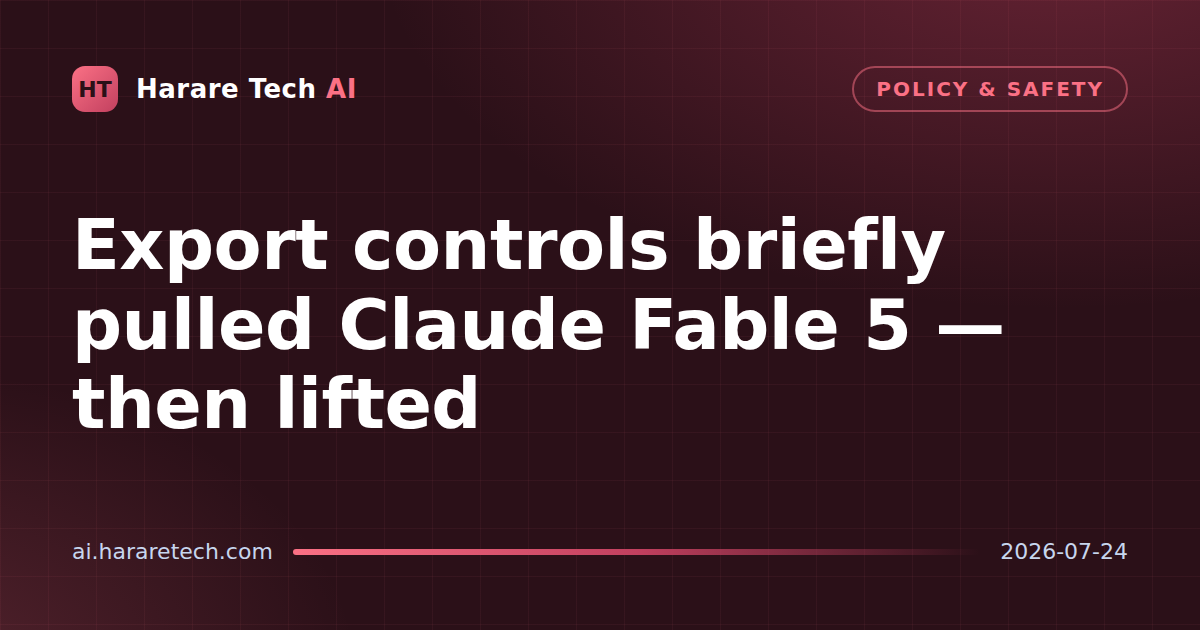
Export controls briefly pulled Claude Fable 5 — then lifted
Reporting on the July 2026 release cycle says export controls on Claude Fable 5 were lifted on 30 June after roughly two and a half weeks, with general availability restored on 1 July.
The most consequential AI story of mid-2026 was not a benchmark. It was a model becoming unavailable.
According to reporting on the July release cycle, the US administration lifted export controls affecting Anthropic's Claude Fable 5 on 30 June 2026, after roughly two and a half weeks of negotiation, and general availability was restored on 1 July. The same reporting says OpenAI opened access to GPT-5.6 only after a twelve-day government review.
We are reporting this as published. Treat the specific durations as journalistic rather than confirmed by primary documents.
Why this matters more here than in California
A US developer experiences an export-control episode as a news cycle. A developer in Harare, Lagos or Nairobi experiences it as a product outage — with no notice, no recourse and no local alternative.
If your business logic depends on a single frontier API and that API's availability is subject to a government review process you cannot see, you are carrying a real operational risk that has nothing to do with model quality.
The mitigation is boring and it works
- Abstract the model behind your own interface. Never call a vendor SDK directly from business logic. One adapter, one swap.
- Keep a second provider warm. Not theoretically — with credentials, a tested prompt set and a known cost per request.
- Keep an open-weight fallback. A model you can run yourself cannot be revoked. It does not need to be as good; it needs to keep the lights on.
- Log your prompts and evaluations. Switching models is easy. Proving the replacement is good enough is not, unless you already have the test set.
The open-weight tier is now good enough for point 3 to be genuinely practical — see our guide to the open-weight landscape.
Keep reading AI news from Harare
Fresh frontier and open-model updates, plus the hardware to run local AI in Zimbabwe.
Browse all AI updates More Policy & Safety Shop hararetech.com Laptop batteries WhatsApp the shop Follow @AICITY112